


Every standup brings the same “All good, no blockers,” while code reviews that took an hour now take two days and tickets close at the exact written scope. Then the resignation lands in the middle of a release. If you work with an outstaffing company, you’ve probably seen this sequence and started counting its cost on the day the resignation arrived.
By then, the expensive part had been running for months. In Stack Overflow’s 2025 survey, 75% of employed developers describe themselves as complacent or not happy at work, and most of them won’t quit this quarter. They stay on the team and deliver less until the market gives them a better option. We run an outstaffing business ourselves, and we’ve seen how vague a contract gets on developer retention.
- The costliest phase of developer turnover starts before the resignation: weeks of partial output at a full rate.
- “Free replacement” in an outstaffing contract covers the search. The vacancy and the ramp-up stay on your side, along with your engineers’ hours.
- Gallup puts the cost of employee turnover at one-half to two times annual salary. With modest sample inputs, the calculator below lands at 32% of the annual seat cost for one departure.
- Ask every vendor for 12-month developer attrition and average tenure on client projects, and treat a refusal to share them as data.
- Retention has two owners: the vendor owns pay and the career path, and you own the scope and how the developer fits into your team.
Why the price per developer is the wrong number to compare
By its founders’ own account, staffing company Remotely Works heard the same story in developer interviews again and again: a developer earns $3,000 a month, the agency bills $60 an hour full-time and keeps about $7,400 of a roughly $10,400 invoice. That gap matters less for your budget than for your team. The margin decides whether a raise exists when your developer becomes the person who knows the codebase.
The rate card shows what a seat costs per hour. The number worth comparing is the 12-month cost of a seat, including the weeks when it underdelivers or sits empty. In the outstaffing model, the vendor employs the developer and handles payroll, taxes and HR, while you direct daily work like any team lead. Outsourcing, employer of record and in-house hiring split those duties differently, and the split decides who pays when someone leaves.
| Model | Who employs the developer | Who manages daily work | Who absorbs turnover cost |
|---|---|---|---|
| Outstaffing | Vendor | You | Vendor pays for the search. You absorb lost output and onboarding |
| Outsourcing | Vendor | Vendor | Vendor, inside the project price. You feel it as delays |
| Employer of record | EOR provider (legally); you choose the person | You | Almost all on you. The EOR runs payroll and compliance, not replacement |
| In-house | You | You | You, in full |
Staff augmentation and dedicated development team offers follow the same turnover math. For Israeli companies, the question sits at the center of the business. The Israel Innovation Authority’s 2025 employment report counts about 440,000 people working for Israeli tech companies abroad, against about 400,000 in Israel. When more than half of the workforce sits outside the country, keeping remote developers belongs in the same conversation as runway, whether you hire locally or work with an outstaffing company in Ukraine.
The two ways a developer leaves, and why the first one costs more
A head of technology at a staff augmentation vendor described the risk bluntly in a sales webinar: without a way to gauge daily output, a developer on an eight-hour bill might deliver what he called “three hours worth of work,” and the low hourly rate stops being low. A resignation is loud and has a date. The quiet exit has neither, and you keep paying the full rate throughout.
Neither exit says anything bad about the developer, since people disengage when growth stalls, pay falls behind or the work stops meaning much. DOU’s 2026 survey of Ukrainian IT specialists names better conditions elsewhere (44%) and no career prospects (41%) as the top two reasons for leaving. The same survey found that 51% fear losing their job, so low churn right now may mean a frozen market rather than a happy team.
| Type of exit | Early signals | Main cost driver | When the client usually notices |
|---|---|---|---|
| Quiet exit (still on the team, mentally gone) | Slower reviews, minimum-scope tickets, silence in planning | Partial output at a full rate, for weeks or months | Late: at a review, a missed deadline or the resignation itself |
| Resignation | Notice letter, handover requests, open job search | Vacancy, ramp-up, lost knowledge | The day the notice arrives |
7 hidden costs of developer turnover in outstaffing
Most models of the cost of employee turnover start counting on resignation day and stop when the replacement signs. In outstaffing, four of the seven costs below fall outside that window, and most of them land on your side of the contract rather than the outstaffing company’s.
1. The disengagement tax before notice
Weeks or months of partial output at a full rate, before anyone mentions leaving.
Hourly and monthly billing both pay for presence. A developer who has mentally left still logs the hours, and nothing on the invoice changes. The signals show up in the work first:
- Code reviews sit longer, and review comments get shorter
- Fewer questions and ideas in sprint planning
- Tickets closed at the exact written scope, with edge cases left for “later”
- Less interest in long-term or architecture tasks
- Shorter async updates and less presence in team channels
None of these proves anything alone, but two or three of them for a month deserve a conversation with the vendor’s HR contact.
Ask your vendor: How do you spot disengagement before a resignation, and when do you tell us?
2. The notice period nobody plans for
The last weeks, when handover quality decides how much knowledge stays.
A developer on notice has little reason to write the documentation they skipped for a year. The developer’s contract with the vendor sets how many weeks you get, and that number can be shorter than your release cycle. Use the weeks with a plan:
- Recorded code walkthroughs of every module they own
- Updated READMEs and runbooks, reviewed by the person taking over
- A written list of open decisions and half-finished work
- Credentials, keys and access revoked on the last day, not a week later
Ask your vendor: What notice period does the developer’s contract set, and who checks the handover?
3. The vacancy gap
The days between the resignation and a replacement’s first commit.
Vendors quote replacement speed as a shortlist date, but your team feels the start date. In between come your own interviews and the candidate’s notice at their current job, plus onboarding admin. Backfilling at home takes time as well, since the Israel Innovation Authority counted about 17,000 open high-tech vacancies in December 2024. A tight international recruitment process shortens the gap, and every empty week still leaves work in the backlog.
Ask your vendor: What is your replacement SLA to the start date, not to the CV shortlist?
4. The ramp-up curve
The weeks a new developer spends learning your codebase instead of shipping.
AI tools have shortened this phase, and DX data from 400 companies puts the average time to a new developer’s 10th pull request at 33 days in April 2026, less than half of what it took in early 2024. Thirty-three days still means about five weeks of partial output, and a 10th PR on a legacy module marks a milestone rather than full speed. The same DX research cites Microsoft’s Brian Houck: by the 10th PR, early habits give a better than even chance of predicting a developer’s output two years out. That puts the cost of replacing an employee well beyond the recruiting fee.
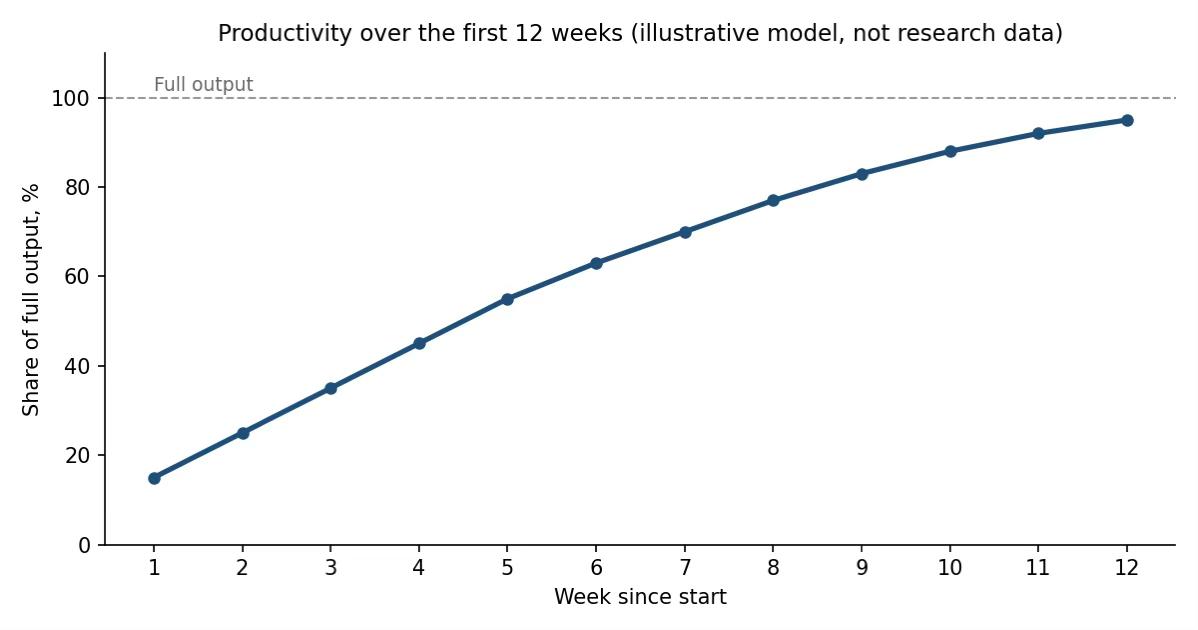
Illustrative model, not research data. Replace it with your own team’s pattern if you track one.
Ask your vendor: Who covers the replacement’s first weeks, when we pay a full rate for partial output?
5. Knowledge that walks out the door
Decisions and workarounds that live in one person’s head.
Every team has “the only person who knows the billing module.” Bus factor is the number of people who can leave before part of your system has no owner, and on outstaffed teams it often sits at one. Three sprint habits keep the loss small:
- Architecture decision records (ADRs) for any choice someone will question later
- Runbooks for deploys, incidents and recurring manual tasks
- An onboarding README that the newest person on the team updates
Frequent rotation makes it worse, as one engineer on Blind found at a company that capped contractor terms at two years. They became the go-to person for a whole domain, their week grew from 35–40 hours to 50–60, and in their words, “I don’t code at all, I can’t get my own work done.”
Ask your vendor: Is knowledge transfer a contractual duty or a favor?
6. Your senior engineers’ time
The hours your strongest people spend on interviews and onboarding instead of building.
This cost never appears on the vendor’s invoice because your own payroll covers it. Fill in the hours with your estimates, and the total goes straight into the calculator below.
| Activity | Who on your side | Hours (your estimate) |
|---|---|---|
| CV screening and first interviews | Team lead | |
| Technical interview | Senior engineer | |
| Onboarding sessions and pairing | Senior engineer | |
| Extra code review in the first weeks | Senior engineers | |
| Context questions and unblocking | Whole team |
Ask your vendor: How much screening do you do before a candidate reaches our engineers?
7. Momentum and trust
The cost of slipped releases and a team that starts to wonder who leaves next.
Gallup points out that many turnover costs never register on a spreadsheet. A slipped release can cost you a demo, a renewal conversation or a strong board update. The people who stay pick up the leftover work and watch how the exit went. If a colleague vanished without a handover, they draw conclusions about their own future on the project.
Ask your vendor: How and when will we hear about a departure, and who tells our team?
How to calculate the cost of developer turnover
Gallup estimates that replacing an employee costs one-half to two times their annual salary, and calls that range conservative. The range stays wide because the biggest parts of the cost of employee turnover come from lost output rather than recruiting fees, so no average cost of turnover per employee fits every seat. For an outstaffed developer, you can estimate your own number with inputs you already know.
The formula in plain words: cost of turnover = disengagement loss + vacancy loss + ramp-up loss + your team’s hours.
- Disengagement loss: weekly seat cost × weeks of disengagement × share of output lost
- Vacancy loss: weekly seat cost × weeks without a developer
- Ramp-up loss: weekly seat cost × ramp-up weeks × (100% − average output during ramp)
- Your team’s hours: internal hours × internal hourly cost
The model values a week of lost output at the weekly seat cost. Treat that as a floor: you pay for a seat because its output is worth more than its price. If you want a salary reference for comparison, the US Bureau of Labor Statistics publishes median pay for software developers.
Turnover cost calculator
This cost of employee turnover calculator takes eight inputs in USD or ILS and returns the total for one departure and its share of the annual seat cost. A worked example with sample inputs:
| Input | Sample value | Result |
|---|---|---|
| Monthly cost of the seat | $6,000 (≈ $1,385 per week) | Annual seat cost: $72,000 |
| Weeks of disengagement / output lost | 8 weeks / 40% | Disengagement loss: $4,431 |
| Vacancy weeks | 6 weeks | Vacancy loss: $8,308 |
| Ramp-up weeks / average output during ramp | 8 weeks / 50% | Ramp-up loss: $5,538 |
| Internal hours / internal hourly cost | 60 hours / $80 | Your team’s hours: $4,800 |
| Total | $23,077, or 32% of the annual seat cost |
Sample inputs for illustration only. Enter your own numbers in the calculator.
The model leaves out momentum and trust, and still lands at a third of a year’s spend on one seat. Double the disengagement to 16 weeks and the total grows by another $4,431, so each extra month of quiet exit adds about $2,400 before anyone has resigned.
What outstaffing companies usually don’t tell you
The founders of Remotely Works wrote openly about their industry’s “perverse incentive to sell juniors as seniors to maximize the margin.” On Hacker News, a former Boeing IT employee described good consultants rotated off his project and replaced with weaker ones, with no warning. We’re an outstaffing company too, and we know our industry keeps this part of the sales conversation short.
Most vendor pages report client retention, or low bars like “80% of our employees stay six months.” Neither number tells you how long a developer stays on your project. Contracts follow the same pattern: the wording sounds complete, and the gaps appear the week someone resigns. The same gaps show up in staff augmentation deals, and most lists of hidden costs of outsourcing skip them.
| What the contract says | What it covers in practice | What to ask for |
|---|---|---|
| “Free replacement” | The vendor’s search and recruiting | Service credits or a reduced rate during the replacement’s first weeks |
| “Replacement in X days” | A CV shortlist within X days | An SLA to the replacement’s start date |
| “Dedicated developer” | The person works only on your project | The pay review cycle and who funds raises |
| Attrition rate | Rarely stated at all | 12-month developer attrition and average tenure on client projects, in writing |
| Handover and overlap | Often silent | Who pays for an overlap period between the leaving developer and the replacement |
Vendor contract guides put conversion fees at 15–25% of first-year salary and non-solicit terms at 12–24 months. Those clauses bite once the developer becomes critical, exactly when you can’t walk away. Agree on the conversion fee before you sign and negotiate a decay after a minimum tenure. A vendor that invests in fair pay and working conditions has less reason to hide these terms.
Questions to ask any outstaffing company before you sign
Tachles: the sales call will cover rates and time zones. The ten questions below cover what happens when a developer stops wanting to stay, and the answers belong in writing rather than in a slide deck.
- What was your developer attrition over the last 12 months, voluntary and company-initiated?
- What is the average tenure of a developer on a client project?
- What is your replacement SLA to the replacement’s start date?
- Who pays for an overlap period between the leaving developer and the replacement?
- How do you spot disengagement early, and when do you tell the client?
- How often do you review developer pay, and who funds a raise?
- What career path does a developer on our project have inside your company?
- Which knowledge-transfer duties does the contract name?
- Can we name key personnel and approve any replacement?
- What is your business continuity plan for Ukraine-based teams, including backup power and relocation?
DOU’s 2026 data explains why question 7 matters: in Ukrainian outstaffing companies, the top reason for company-initiated exits is a project ending (31%). Outstaffing developers know it, so a clear career path matters to them as much as to you. For IT outstaffing in Ukraine, question 10 needs a concrete answer, not a reassurance. If you’re still weighing when outstaffing makes sense, these answers show which outstaffing benefits you’d get in practice.
What keeps developers on an outstaffed team
In Stack Overflow’s 2025 survey, liking your manager ranks ninth among job-satisfaction factors. Autonomy and trust, competitive pay and solving real-world problems take the top three. Structure beats charm, and on an outstaffed team the structure has two owners.
We’d push back on the most common assumption here, that retention is the vendor’s job. A study of 8,283 agency workers in Italy found that support from the client predicts commitment to the client and to the agency, and the two commitments reinforce each other. If you treat an outstaffed developer as a rented resource, you undercut the vendor’s retention work too.
| What the vendor must do | What the client must do |
|---|---|
| Review pay on a fixed cycle and fund raises from its margin | Tell the vendor when the developer’s scope grows, so pay can follow |
| Run career conversations and offer a growth path | Give ownership of meaningful parts of the product, not leftover tickets |
| Hold regular 1:1s and flag risk early | Give direct feedback through regular performance conversations |
| Keep employment, payroll and compliance stable | Include the developer in planning, demos and credit, like anyone on staff |
Our guide on what good outstaffing collaboration looks like covers the working rhythm in more detail.
How Lagoteam handles developer retention
Lagoteam is an outstaffing company in Ukraine working with Israeli tech teams. We employ the developers, and our HR team runs the part of retention that sits with the vendor. Every developer has regular 1:1s with HR, separate from project conversations with the client. We review pay on a set cycle, so a raise doesn’t wait for a resignation. Payroll and compliance stay with us, so the developer deals with one employer and you deal with one invoice.
Our model has the same weak spot as any outstaffing setup: we hold the employment contract, but you see the developer’s work every day, so the first signs of a quiet exit often reach you before they reach our HR. When our HR or delivery team sees a risk, such as a stalled growth conversation, a pay gap or signs of burnout, we tell you early and come with options instead of a surprise notice. Companies that hire developers directly can use the same process through our HR outsourcing service.
Conclusion
The largest share of the cost of employee turnover arrives while the developer is still on the team, and most outstaffing contracts leave that phase on your side, together with the vacancy and the ramp-up. When you compare vendors, put 12-month attrition and tenure on client projects next to the hourly rate, and ask for a replacement SLA counted to the start date. Retention holds up when the vendor and the client each know which half of it they own.
If you want a second pair of eyes on your current vendor contract, book a 30-minute call with us. We’ll go through it against the checklist above and show you where the gaps are, whether or not you end up working with Lagoteam as your outstaffing company in Ukraine.
FAQ
How much does it cost to replace a software developer?
Gallup estimates that replacing an employee costs one-half to two times their annual salary. For a developer, most of that cost comes from lost output during disengagement, the vacancy and the ramp-up, not from the recruiting fee.
Who pays when an outstaffed developer quits?
The outstaffing company usually pays for finding a replacement. The client absorbs lost output, delayed releases and the time its own engineers spend onboarding the new person, unless the contract covers an overlap period or service credits. Check that clause before you sign.
What developer attrition rate should I expect from an outstaffing company?
No single benchmark applies to every market and stack, so ask each vendor for its developer attrition over the last 12 months and the average tenure on client projects. Compare vendors on those two numbers. A vendor that won’t share them is giving you an answer too.
How can I tell an outstaffed developer is planning to leave?
Watch for slower code reviews, fewer questions and ideas in planning, tickets done to the minimum scope and less interest in long-term tasks. None of these proves anything alone, so raise them early with the vendor’s HR contact, who can talk to the developer about pay, workload or growth.
Is outstaffing riskier than in-house hiring for developer retention?
Not by default. The risk grows when neither the vendor nor the client owns retention: the vendor holds the employment contract, the client holds the daily work. Outstaffing works best when both sides agree who handles pay reviews, career growth and early warning signs.